Introduction
Search is changing faster than ever. People are no longer searching only with short keywords such as “digital marketing agency” or “best SEO company.” They are increasingly using longer, conversational queries and expecting search engines to understand context, intent, and follow-up questions.
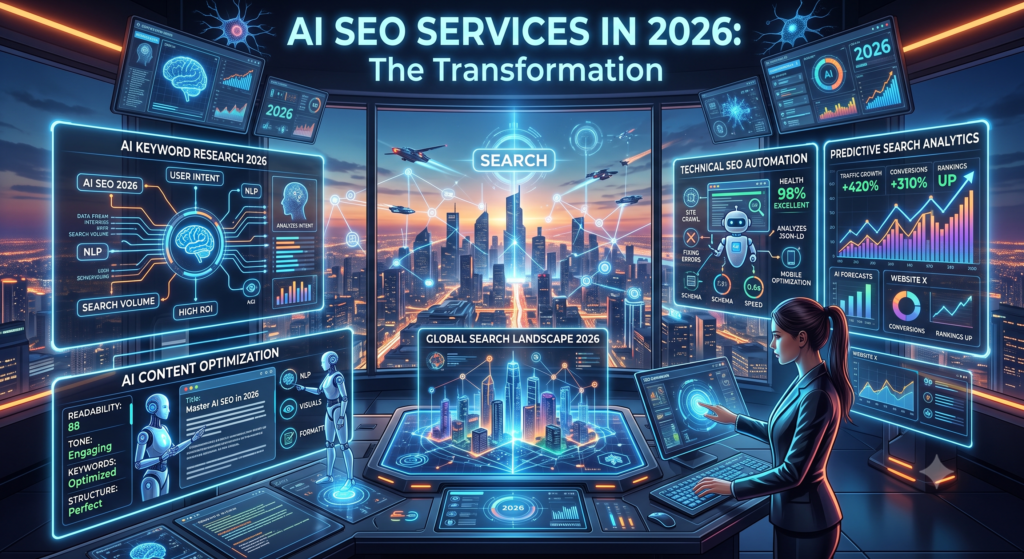
At the same time, artificial intelligence is changing how marketers research keywords, analyze competitors, optimize content, identify technical issues, and interpret SEO data.
This is where AI SEO Services are becoming increasingly relevant.
AI does not replace the fundamentals of SEO. Instead, it gives SEO professionals better ways to process information, automate repetitive tasks, identify patterns, and make data-informed decisions.
For businesses, the goal should not be to publish as much AI-generated content as possible. Google emphasizes helpful, reliable, people-first content and warns against using automation primarily to manipulate search rankings.
In this guide, we will explore what AI SEO Services are, how artificial intelligence is transforming SEO in 2026, the services businesses can use, common mistakes to avoid, and how SEO is adapting to AI-powered search experiences.
Table of Contents
- Introduction
- What Are AI SEO Services?
- Why Are AI SEO Services Important in 2026?
- How Artificial Intelligence Is Transforming SEO
- AI-Powered Keyword Research
- Search Intent Analysis
- AI Content Optimization
- AI Competitor Analysis
- AI-Powered Technical SEO
- AI SEO Analytics and Reporting
- How AI SEO Services Help Businesses
- Key AI SEO Services Businesses Can Use
- AI Keyword Research Services
- AI Content Optimization Services
- AI Competitor Analysis Services
- AI Technical SEO Services
- AI Local SEO Services
- AI SEO Analytics and Reporting
- AI SEO vs Traditional SEO: What’s the Difference?
- How AI Is Changing Google Search
- Best AI SEO Strategies for 2026
- Use AI for Research, Not Blind Publishing
- Combine AI With Human Expertise
- Create Original Insights and Examples
- Focus on Search Intent
- Improve Content Depth and Relevance
- Use Structured Data Correctly
- Monitor SEO Performance Regularly
- Optimize for Traditional and AI Search
- Common AI SEO Mistakes to Avoid
- How to Choose the Right AI SEO Service
- The Future of AI SEO Services
- Conclusion
- Frequently Asked Questions About AI SEO Services
What Are AI SEO Services?
AI SEO Services are SEO services that use artificial intelligence, machine learning, automation, and data analysis to improve different parts of the search optimization process.
Traditional SEO often involves manually researching keywords, analyzing competitors, reviewing website data, checking technical issues, and planning content.
AI-powered SEO can make many of these processes faster.
For example, an AI-assisted SEO workflow might analyze hundreds of keywords, group them according to search intent, identify related topics, compare competitor content, and highlight potential content gaps. An SEO professional can then review those findings and build a strategy around them.
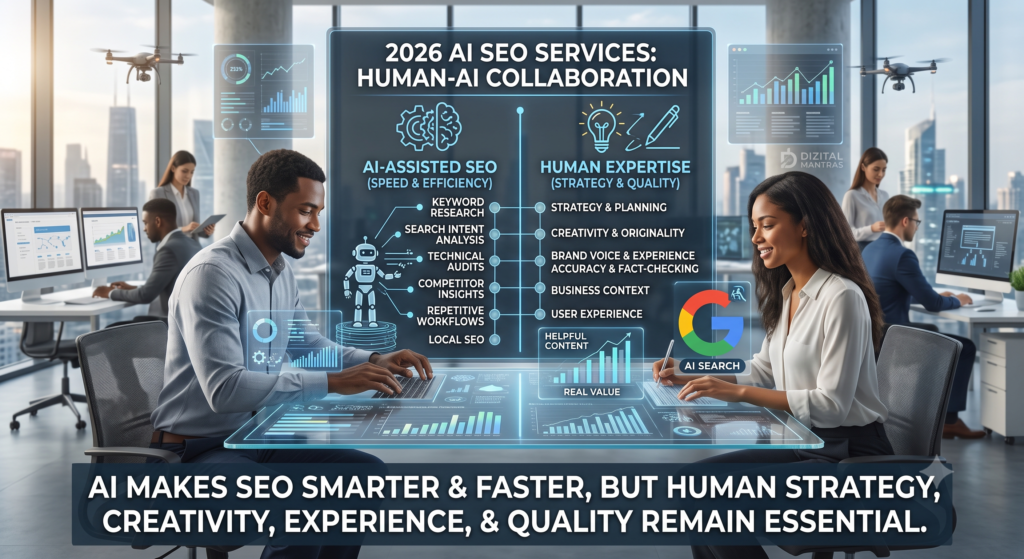
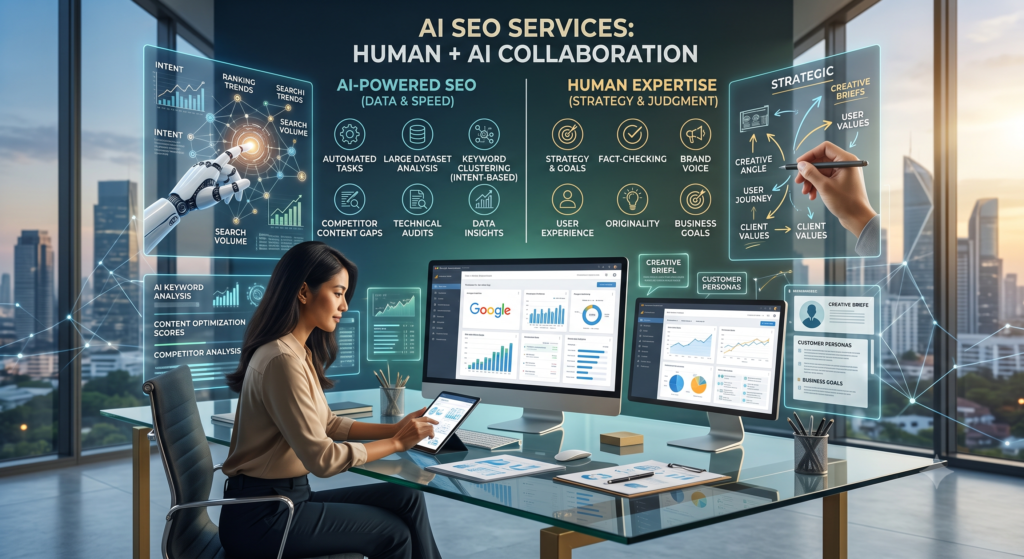
The important point is that AI should support SEO professionals rather than completely replace human expertise.
Human judgment is still necessary for strategy, fact-checking, brand voice, originality, user experience, and understanding business goals.
Why Are AI SEO Services Important in 2026?
AI is becoming an important part of SEO because both search behavior and the search experience are evolving.
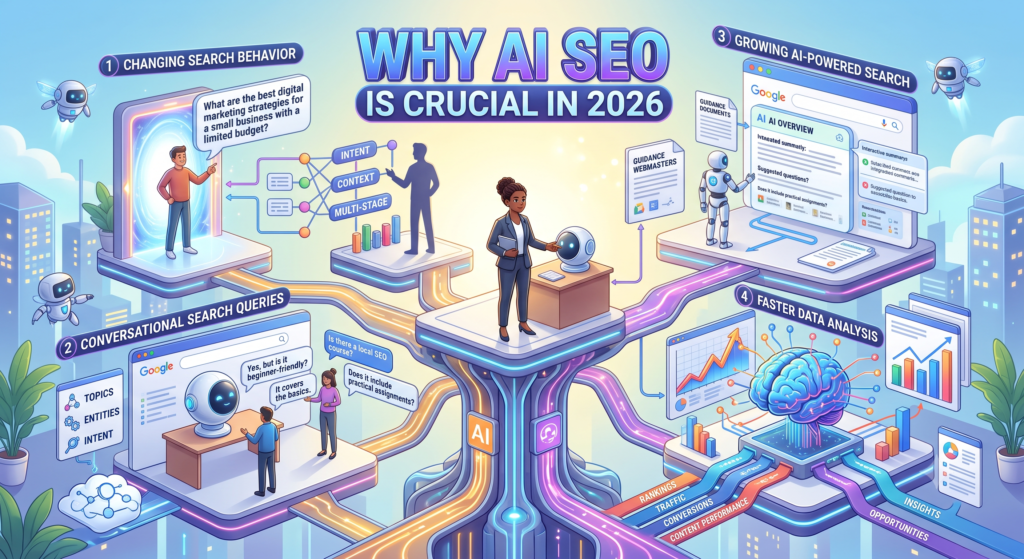
Changing Search Behavior
Users increasingly ask complete questions instead of typing only a few keywords.
For example:
“What are the best digital marketing strategies for a small business with a limited budget?”
This type of query contains more context and requires a deeper understanding of search intent.
Conversational Search Queries
AI-powered interfaces encourage people to search conversationally. Users may ask a question, receive an answer, and then ask a follow-up question without starting a completely new search.
SEO strategies therefore need to consider topics, entities, context, and intent—not just individual keywords.
Growing AI-Powered Search
Google’s search experience increasingly includes AI-powered features such as AI Overviews and AI Mode. Google has also published guidance explaining that many established SEO practices continue to matter for its AI search experiences.
This does not mean businesses can guarantee visibility in AI Overviews or AI Mode. Instead, websites should continue creating useful content that can be understood, crawled, and indexed effectively.
Faster Data Analysis
Modern websites can generate large amounts of SEO data.
AI can help marketers identify patterns in rankings, traffic, clicks, conversions, and content performance more efficiently.
The result is not automatically better rankings. Rather, it can help SEO teams spend more time on strategy and less time on repetitive analysis.
How Artificial Intelligence Is Transforming SEO
AI-Powered Keyword Research
Keyword research is one of the areas where AI can save significant time.
AI keyword research can help identify:
- Search trends
- Long-tail keywords
- Keyword clusters
- Related topics
- Question-based queries
- Search intent
Instead of creating a list of isolated keywords, marketers can build topic clusters around a central subject.
For example, a website targeting “digital marketing” could identify related topics such as SEO, PPC, social media marketing, content marketing, email marketing, marketing automation, and AI marketing.
The SEO professional still needs to evaluate search relevance, competition, business value, and actual user needs.
Search Intent Analysis
Search intent refers to the reason behind a user’s search.
The four common categories are:
- Informational: The user wants information.
- Navigational: The user wants to find a specific website or page.
- Commercial: The user is researching products or services before making a decision.
- Transactional: The user is ready to take an action such as buying, booking, or signing up.
AI can help classify large numbers of queries according to likely intent.
This can help businesses create the right content for the right stage of the customer journey.
AI Content Optimization
AI content optimization can assist marketers with:
- Content structure
- Topic coverage
- Readability
- Semantic relevance
- Content organization
- Internal linking opportunities
However, optimization should not mean simply inserting more keywords.
Google’s guidance emphasizes original, useful, accurate, people-first content. AI-generated content does not receive a special ranking advantage simply because AI was used.
Human editing is therefore essential for adding experience, examples, opinions, context, and original insights.
AI Competitor Analysis
AI can process competitor data and help marketers identify:
- Competitor keywords
- Content gaps
- Topic opportunities
- Search trends
- Frequently covered subjects
- Potential weaknesses in competing content
For example, if several competitors discuss the same topic but fail to explain implementation steps, a business could create a more practical guide.
The objective should be to add value—not simply rewrite competitors’ content.
AI-Powered Technical SEO
Technical SEO involves making a website easier for search engines to crawl, understand, and index.
AI and automation can assist with:
- Crawlability checks
- Broken-link detection
- Metadata analysis
- Indexing issues
- Website structure
- Technical audits
- Large-scale website monitoring
For large websites, automated systems can make it easier to identify problems across hundreds or thousands of pages.
Still, technical recommendations should be reviewed before implementation because website architecture and business requirements vary.
AI SEO Analytics and Reporting
AI can help analyze:
- Organic traffic
- Rankings
- Click-through rates
- Conversions
- Content performance
- Search trends
- Landing-page performance
Instead of looking only at individual numbers, marketers can use AI-assisted analysis to identify relationships and trends that deserve human investigation.
How AI SEO Services Help Businesses
The practical benefits of AI SEO Services include:
- Saving time: Automates repetitive SEO tasks.
- Improving efficiency: Helps teams process large datasets faster.
- Finding keyword opportunities: Identifies related queries and topic clusters.
- Understanding search intent: Helps classify and interpret user queries.
- Improving content optimization: Supports content planning and structure.
- Detecting technical issues: Helps identify website problems at scale.
- Supporting data-driven decisions: Turns large datasets into useful insights.
- Making SEO scalable: Allows teams to manage larger websites and content libraries more efficiently.
Practical Example
Imagine a small local bakery wants to increase organic traffic.
Instead of manually researching every possible query, an AI-assisted SEO workflow could identify searches related to birthday cakes, custom cakes, wedding cakes, cake delivery, and local cake shops.
The SEO professional could then evaluate those opportunities and create useful pages around the most relevant topics.
The business might also use AI to identify technical issues, improve page structure, analyze competitors, and monitor performance.
Digital marketing brands such as Dizital Mantras can incorporate AI-assisted research and optimization into broader SEO strategies while keeping human planning and quality control at the center.
Key AI SEO Services Businesses Can Use
AI Keyword Research Services
What it means: Using AI to discover and organize relevant keyword opportunities.
How AI helps: It can identify keyword relationships, long-tail variations, questions, and topic clusters.
Why it matters: Businesses can build more comprehensive content strategies.
Example: A SaaS company can discover multiple search queries around its main software category and organize them into content clusters.
AI Content Optimization Services
What it means: Using AI-assisted analysis to improve content structure and relevance.
How AI helps: AI can identify missing topics, readability issues, related concepts, and internal-linking opportunities.
Why it matters: Better-organized content can provide a clearer experience for users.
Example: An e-commerce website can use AI-assisted analysis to identify important information missing from product category pages.
AI Competitor Analysis Services
What it means: Using AI to analyze competing websites and identify opportunities.
How AI helps: It can organize competitor keywords, topics, content formats, and potential gaps.
Why it matters: Businesses can identify areas where they can provide more useful information.
Example: A marketing agency can compare competitors’ content and identify questions that are not being answered well.
AI Technical SEO Services
What it means: Applying automation and AI-assisted analysis to technical SEO.
How AI helps: It can identify patterns in broken links, metadata problems, crawl issues, and other technical signals.
Why it matters: Large websites can be difficult to audit manually.
Example: An online store with thousands of pages can use automated checks to identify missing metadata or broken internal links.
AI Local SEO Services
What it means: Using AI-assisted research and analysis to improve local search visibility.
How AI helps: It can help organize local keyword themes, customer questions, location-based content ideas, and review insights.
Why it matters: Local businesses need to understand what nearby customers are searching for.
Example: A dental clinic could create useful content around location-specific questions and common dental services.
AI SEO Analytics and Reporting
What it means: Using AI to analyze SEO performance data.
How AI helps: It can identify trends and highlight areas that require attention.
Why it matters: Faster analysis can support better marketing decisions.
Example: An SEO team can use automated reporting to identify pages losing organic traffic and investigate the reasons.
AI SEO vs Traditional SEO: What’s the Difference?
| SEO Factor | Traditional SEO | AI-Powered SEO |
|---|---|---|
| Keyword Research | Mostly manual research | AI-assisted discovery and clustering |
| Content Optimization | Manual review | AI-assisted analysis plus human editing |
| Competitor Analysis | Manual comparison | Faster large-scale data analysis |
| Data Analysis | Spreadsheet and dashboard review | AI-assisted pattern detection |
| Technical SEO | Manual and automated tools | More AI-assisted issue identification |
| Reporting | Manually prepared reports | Automated and AI-assisted insights |
| Speed | Can take more time | Faster for repetitive tasks |
| Scalability | Limited by manual workload | Easier to scale |
| Human Expertise | Essential | Still essential |
AI-powered SEO does not eliminate traditional SEO fundamentals. Keyword research, quality content, technical SEO, internal linking, crawlability, site architecture, and user experience remain important.
The difference is that AI can make some processes faster and more data-driven.
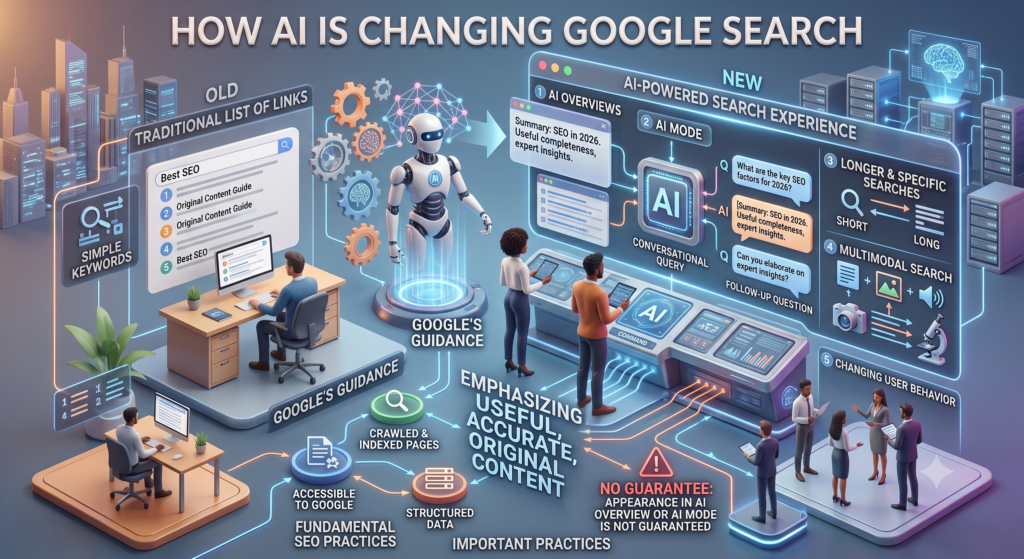
How AI Is Changing Google Search
Google Search is evolving from a traditional list of links toward more interactive and AI-powered experiences.
This includes developments such as:
- AI Overviews
- AI Mode
- Conversational queries
- Longer and more specific searches
- Follow-up questions
- Multimodal search
- Changing user behavior
- Greater emphasis on useful and original content
Google’s current guidance for AI search experiences continues to emphasize fundamental SEO practices, including making content accessible to Google, ensuring pages can be crawled and indexed, and using structured data correctly when appropriate.
Importantly, no SEO provider can guarantee that a website will appear in an AI Overview or AI Mode response.
Businesses should focus instead on creating content that is genuinely useful, accurate, original, accessible, and relevant to their audience.

Best AI SEO Strategies for 2026
1. Use AI for Research, Not Blind Publishing
Use AI to generate ideas, organize information, identify patterns, and support research.
Do not publish everything an AI system produces without review.
2. Combine AI With Human Expertise
AI can process information quickly, but humans provide experience, judgment, creativity, and context.
A strong workflow combines both.
3. Create Original Insights and Examples
Do not simply summarize what already exists online.
Add original examples, practical experiences, analysis, comparisons, or useful explanations.
4. Focus on Search Intent
Before creating content, ask:
What does the user actually want to accomplish?
The answer should influence the content format, depth, tone, and call to action.
5. Improve Content Depth and Relevance
Cover the topic thoroughly without adding unnecessary information.
The objective is useful completeness—not word count for its own sake.
6. Use Structured Data Correctly
Structured data can help search engines understand page content and can support eligibility for certain search features.
However, it should accurately represent visible page content and follow Google’s guidelines.
7. Monitor SEO Performance Regularly
Track traffic, rankings, clicks, conversions, and content performance.
Use AI to assist analysis, but investigate important changes before taking action.
8. Optimize for Traditional and AI Search
Do not create a completely separate SEO strategy based only on AI search.
Strong technical SEO, helpful content, accessibility, crawlability, and clear information architecture remain foundational.
Common AI SEO Mistakes to Avoid
Businesses should avoid:
- Publishing unedited AI-generated content
- Keyword stuffing
- Producing large volumes of low-value pages
- Ignoring fact-checking
- Copying competitor content
- Ignoring search intent
- Depending completely on AI
- Creating content primarily to manipulate rankings
- Making unsupported AI SEO claims
Using AI is not automatically a problem.
The bigger issue is how and why it is used.
Google’s spam policies specifically address scaled content abuse, including using generative AI to create many pages primarily for manipulating search rankings when those pages provide little value to users.
How to Choose the Right AI SEO Service
Before hiring an AI SEO provider, evaluate:
- SEO experience
- AI expertise
- Human oversight
- Content quality
- Technical SEO knowledge
- Transparent reporting
- Customized strategy
- Ethical AI usage
- Understanding of Google’s guidelines
- Clear business goals
Avoid providers that promise guaranteed rankings, guaranteed AI Overview placement, or instant SEO success through AI.
A reliable provider should be able to explain what it is doing, why it is doing it, how success will be measured, and where human review is involved.
Brands such as Dizital Mantras can combine SEO, content, website optimization, and modern AI-assisted marketing approaches as part of a broader digital marketing strategy.
Businesses should also evaluate SEO recommendations critically and compare important claims with official Google Search Central documentation.
The Future of AI SEO Services
The future of AI SEO Services is likely to involve deeper integration between AI and traditional digital marketing workflows.
Potential developments include:
- AI-powered search
- AI agents
- Predictive SEO
- Automated SEO workflows
- Personalized search experiences
- Multimodal search
- AI-assisted content discovery
- Advanced SEO analytics
- Integration of AI with broader digital marketing
These areas are evolving, so businesses should avoid treating predictions as guaranteed outcomes.
The most sustainable approach is to build flexible SEO systems that can adapt as search behavior and technology change.
Conclusion
AI SEO Services are changing how businesses approach search engine optimization in 2026.
AI can help with keyword research, search intent analysis, content optimization, competitor research, technical SEO, local SEO, analytics, and repetitive workflows.
But AI is not a shortcut to guaranteed rankings.
The strongest SEO strategies combine artificial intelligence with human expertise. AI can help marketers process information faster and identify opportunities, while human professionals remain responsible for strategy, creativity, accuracy, originality, quality, and business context.
As Google continues developing AI-powered search experiences, the fundamentals remain important: create helpful and reliable content, make websites accessible and crawlable, understand your audience, and provide genuine value.
For businesses exploring modern SEO, Dizital Mantras represents the type of digital marketing approach where traditional SEO principles can be combined with newer AI-assisted workflows.
The key takeaway is simple:
AI can make SEO smarter and more efficient, but human strategy, creativity, experience, and quality remain essential.