Introduction
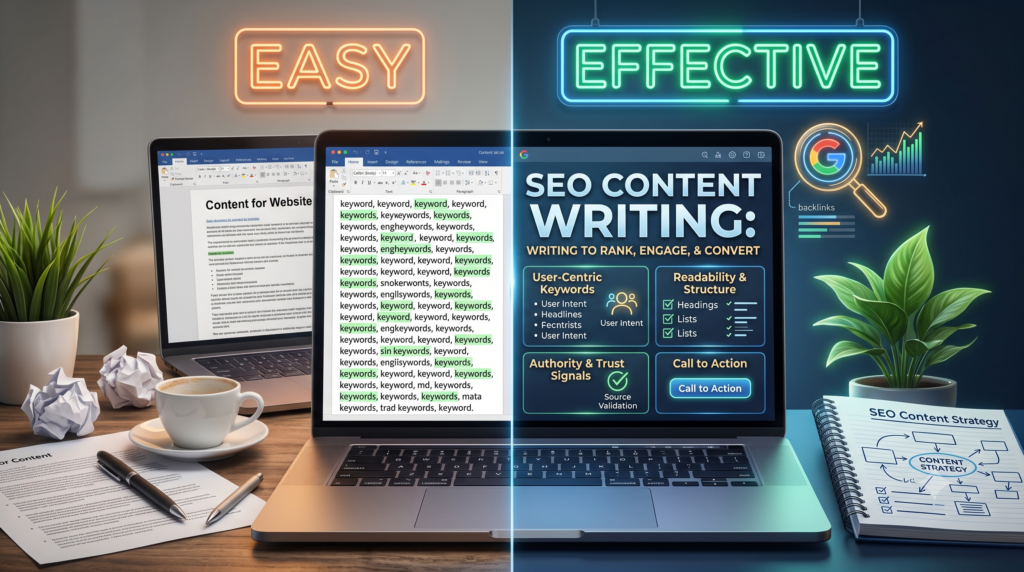
Creating content for a website is easy. Creating content that people actually find on Google, read, trust, and act on is a different challenge. This is where SEO content writing becomes important.
Good SEO content is not about repeating a keyword again and again. It is about understanding what your audience wants, answering their questions clearly, and making the content easy for both readers and search engines to understand.
Whether you are a blogger, website owner, digital marketing student, or small business owner, learning the right SEO Content Writing Tips can help you create useful content that has a better chance of gaining organic visibility.
In this guide, you will learn practical SEO Content Writing Tips that can help you write content that is useful for readers and optimized for search engines.
What Is SEO Content Writing?
SEO content writing is the process of creating useful, relevant, and well-structured content that is designed to satisfy readers’ needs while also being easy for search engines to understand.
Traditional content writing may focus mainly on informing or entertaining the reader. SEO content writing adds another layer: it considers keywords, search intent, headings, links, content structure, and other optimization elements.
For example, suppose you want to write about healthy breakfast ideas.
A normal article might simply list breakfast recipes. An SEO-focused article could target a relevant search query such as “healthy breakfast ideas for busy mornings”, explain the topic clearly, organize recipes under useful headings, add relevant internal links, optimize images, and answer common questions.
The goal is not to write for Google alone. The goal is to create the best possible answer for the person searching.

Why Is SEO Content Writing Important?
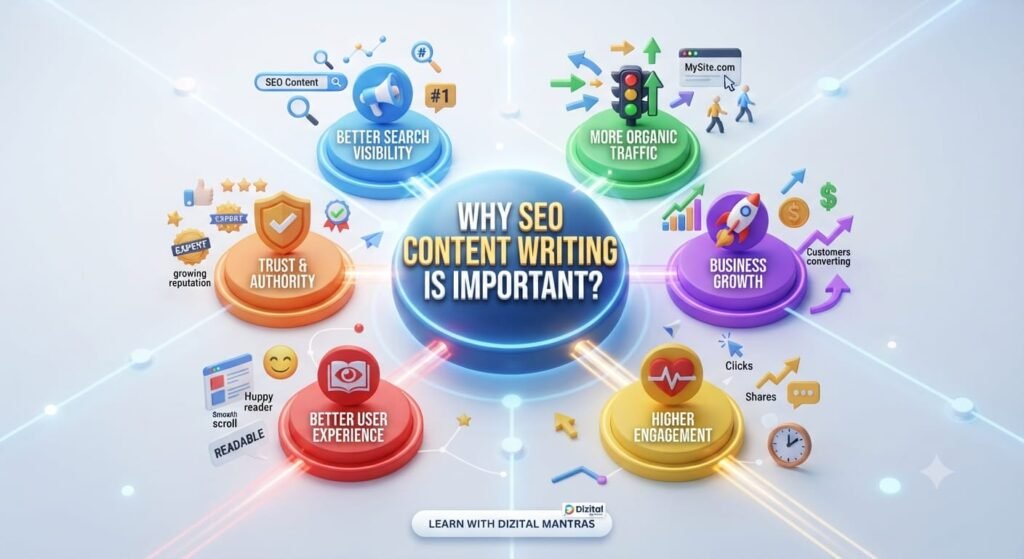
Strong SEO content can support both your website’s visibility and your overall digital marketing strategy.
Here are some important benefits:
- Better search visibility: Well-optimized content can help search engines understand your topic and relevance.
- More organic traffic: Content that appears for relevant searches can bring visitors without paying for every click.
- Better user experience: Clear headings, short paragraphs, and useful information make content easier to consume.
- Higher engagement: Helpful content encourages visitors to spend more time exploring your website.
- Trust and authority: Consistently publishing valuable content can help establish your website as a useful resource.
- Business growth: Informative content can attract potential customers at different stages of their buying journey.
For learners and businesses working on digital marketing, platforms such as Dizital Mantras can also help build a stronger understanding of SEO, content, and other digital marketing skills.
15 SEO Content Writing Tips to Write Content That Ranks
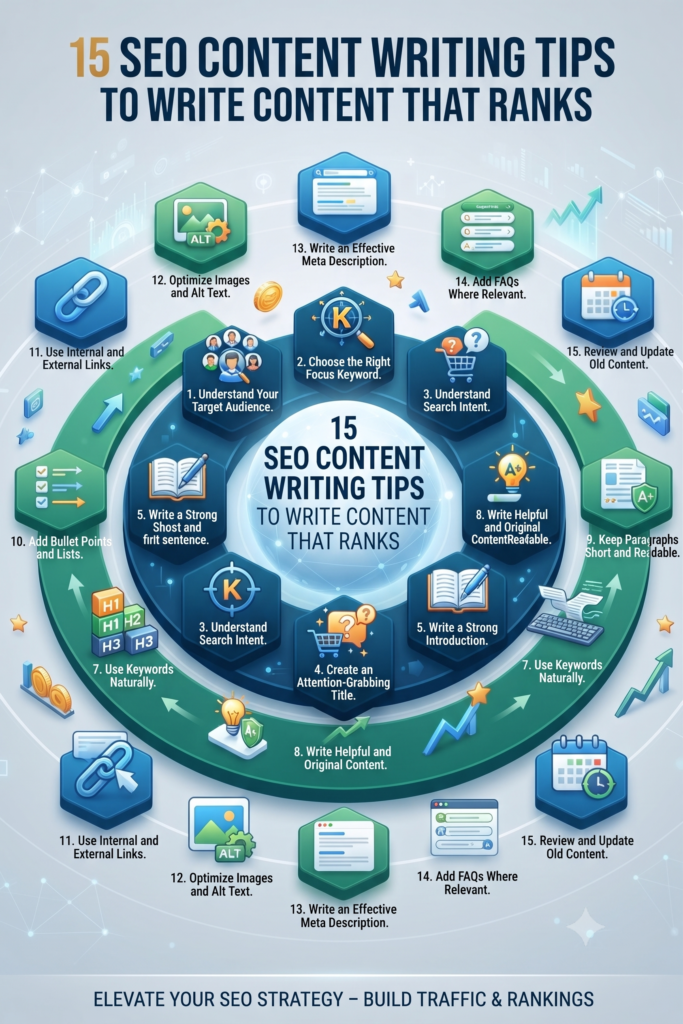
Let’s look at some practical SEO Content Writing Tips you can apply to your next blog post.
1. Understand Your Target Audience
Before writing a single sentence, understand who you are writing for.
Ask yourself:
- Who will read this content?
- What problem are they trying to solve?
- What level of knowledge do they have?
- What information are they expecting?
- What action should they take after reading?
For example, a beginner searching for “what is SEO?” needs a simple explanation. An experienced SEO professional may want technical details and advanced strategies.
Why it matters: When you understand your audience, you can choose the right language, examples, depth, and tone.
Practical example: If your audience is small business owners, explain SEO using business-related examples instead of highly technical terminology.
2. Choose the Right Focus Keyword
A focus keyword is the main search phrase your content is targeting.
For this article, the primary keyword is SEO Content Writing Tips.
Before selecting a keyword, consider:
- Search relevance
- Search intent
- Competition
- Topic relevance
- What your audience is actually searching for
Do not choose a keyword simply because it has a high search volume. It should also match the purpose of your content.
Why it matters: A relevant keyword helps search engines understand the main topic of your page.
3. Understand Search Intent
Search intent means the reason behind a person’s search.
Someone searching for “SEO content writing tips” probably wants practical advice. Someone searching for “SEO content writing course” may be looking for training.
Common search intents include:
- Informational: Looking for information
- Navigational: Looking for a particular website or page
- Commercial: Comparing products or services
- Transactional: Ready to take an action or make a purchase
Practical example: If the search intent is informational, focus on answering questions rather than immediately promoting a service.
Matching search intent is one of the most important SEO writing tips because even well-written content may struggle if it does not satisfy what users actually want.
4. Create an Attention-Grabbing Title
Your title is often the first thing a potential reader notices.
A strong SEO title should be:
- Clear
- Relevant
- Specific
- Interesting
- Naturally optimized for the main keyword
Instead of:
“Writing Content for Websites”
Try:
“SEO Content Writing Tips: How to Write Content That Ranks on Google”
The second title tells readers exactly what they will learn.
Avoid misleading headlines. A catchy title is useful only when the article actually delivers what it promises.
5. Write a Strong Introduction
Your introduction should quickly tell readers:
- What the article is about
- Why the topic matters
- What they will learn
Avoid starting with unnecessary background information.
For example:
“Writing content is not enough to grow a website. Your content needs to answer real questions, match search intent, and provide useful information.”
This immediately establishes the problem and gives readers a reason to continue.
Naturally include your primary keyword in the introduction, but never force it.
6. Use Proper H1, H2, and H3 Headings
A good heading structure makes your article easier to scan.
A simple structure could be:
- H1: Main article title
- H2: Major sections
- H3: Subtopics under an H2
For example:
H1: SEO Content Writing Tips
H2: Why Is SEO Content Writing Important?
H2: SEO Content Writing Tips
H3: Understand Your Target Audience
H3: Choose the Right Focus Keyword
Good headings also help readers quickly find the information they need.
7. Use Keywords Naturally
Keywords are important, but keyword stuffing can make your writing awkward and difficult to read.
Instead of repeating the exact keyword constantly, use related phrases naturally, such as:
- SEO content writing
- SEO-friendly content
- content optimization
- SEO writing tips
- content writing for SEO
- how to write SEO content
For example, instead of writing:
“SEO Content Writing Tips are important because SEO Content Writing Tips help with SEO Content Writing…”
write naturally and focus on explaining the topic.
Rule of thumb: Write for people first and optimize for search engines second.
8. Write Helpful and Original Content
One of the strongest SEO content writing best practices is to provide genuine value.
Don’t create an article simply to target a keyword. Ask:
“Will this article actually help someone solve their problem?”
Add:
- Original explanations
- Practical examples
- Useful tips
- Relevant data when appropriate
- Personal insights or experience
- Clear solutions
Avoid copying sentences or ideas from competitors. Instead, research the topic, understand it, and explain it in your own words.
9. Keep Paragraphs Short and Readable
Large blocks of text can make online content difficult to read, especially on mobile devices.
Try to keep most paragraphs around 2–4 sentences.
You can also improve readability by using:
- Short sentences
- Clear subheadings
- Bullet points
- Numbered lists
- Bold text for important concepts
Good formatting doesn’t just make an article look better. It makes information easier to understand.
10. Add Bullet Points and Lists
People often scan online content before deciding whether to read it fully.
Bullet points make important information easier to find.
For example, when explaining the benefits of SEO content, you can write:
- Increased organic visibility
- Better user experience
- More relevant website traffic
- Improved content engagement
- Stronger brand credibility
Use lists when they genuinely improve clarity. Don’t turn every paragraph into a bullet list.
11. Use Internal and External Links
Internal links connect one page of your website to another relevant page.
For example, an article about SEO content writing could link to your website’s articles about:
- Keyword research
- On-page SEO
- Technical SEO
- Content marketing
Internal linking helps visitors discover related information and helps search engines understand the relationship between pages.
External links can also be useful when you reference trustworthy and relevant sources.
Always make sure your links are useful rather than adding links just for SEO.
12. Optimize Images and Alt Text
Images can make your content more engaging, but they should also be properly optimized.
Useful image optimization practices include:
- Use relevant images
- Compress large image files
- Choose descriptive file names
- Add meaningful alt text
- Avoid unnecessary decorative images
For example, instead of generic alt text like:
“image123”
use something descriptive such as:
“SEO content writing tips checklist”
Alt text should describe the image accurately. Don’t fill it with keywords.
13. Write an Effective Meta Description
A meta description is a short summary that can appear below your page title in search results.
A useful meta description should:
- Explain what the page offers
- Include the main keyword naturally
- Encourage a click
- Accurately represent the content
For example:
“Learn practical SEO Content Writing Tips to create helpful, optimized content that attracts readers and improves your chances of ranking on Google.”
Avoid making promises that the article doesn’t fulfill.
14. Add FAQs Where Relevant
FAQs can address questions readers commonly have about your topic.
For an article about SEO content writing, relevant questions could include:
- What is SEO content writing?
- How do I write SEO-friendly content?
- How often should I use keywords?
- What makes content rank on Google?
- Is SEO content different from normal content?
FAQs can improve the usefulness of your article and help you cover important subtopics naturally.
However, don’t add questions simply to make an article longer. Every FAQ should provide genuine value.
15. Review and Update Old Content
SEO content writing does not always end when you press Publish.
Information can become outdated. Search behavior can change. Your website may also publish new pages that are relevant to older articles.
Regularly review important content and check:
- Are statistics still accurate?
- Are links working?
- Is the information current?
- Can sections be improved?
- Are there new questions worth answering?
- Can internal links be added?
Updating useful older content can be an important part of a long-term content strategy.
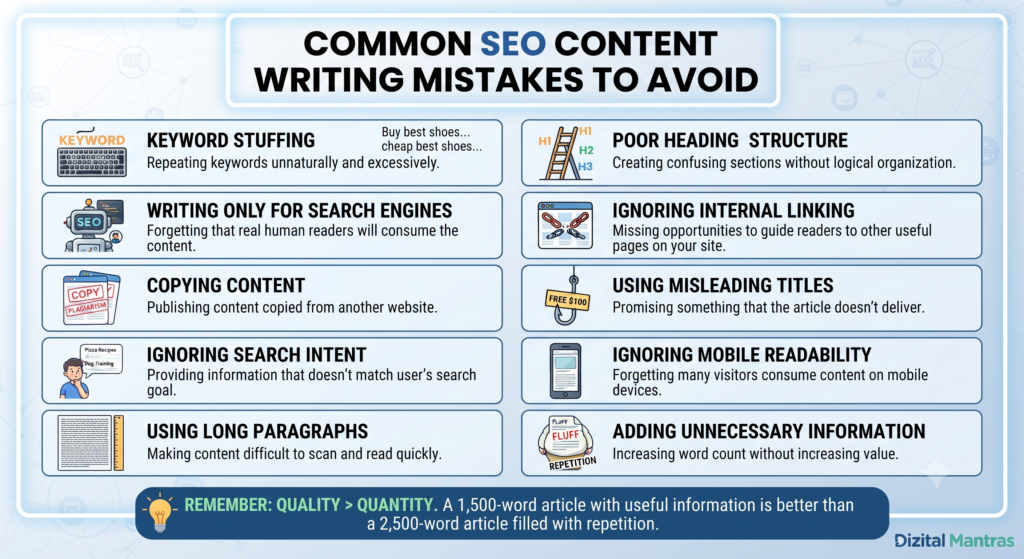
Common SEO Content Writing Mistakes to Avoid
Even a well-written article can lose its effectiveness because of basic SEO mistakes.
Avoid these common problems:
- Keyword stuffing: Repeating keywords unnaturally.
- Writing only for search engines: Forgetting that real people will read the article.
- Copying content: Publishing content that is copied from another website.
- Ignoring search intent: Providing information that doesn’t match what users want.
- Using long paragraphs: Making content difficult to scan.
- Poor heading structure: Creating confusing sections without logical organization.
- Ignoring internal linking: Missing opportunities to guide readers to useful pages.
- Using misleading titles: Promising something that the article doesn’t deliver.
- Ignoring mobile readability: Forgetting that many visitors consume content on smartphones.
- Adding unnecessary information: Increasing word count without increasing value.
Remember, a 1,500-word article with useful information is better than a 2,500-word article filled with repetition.
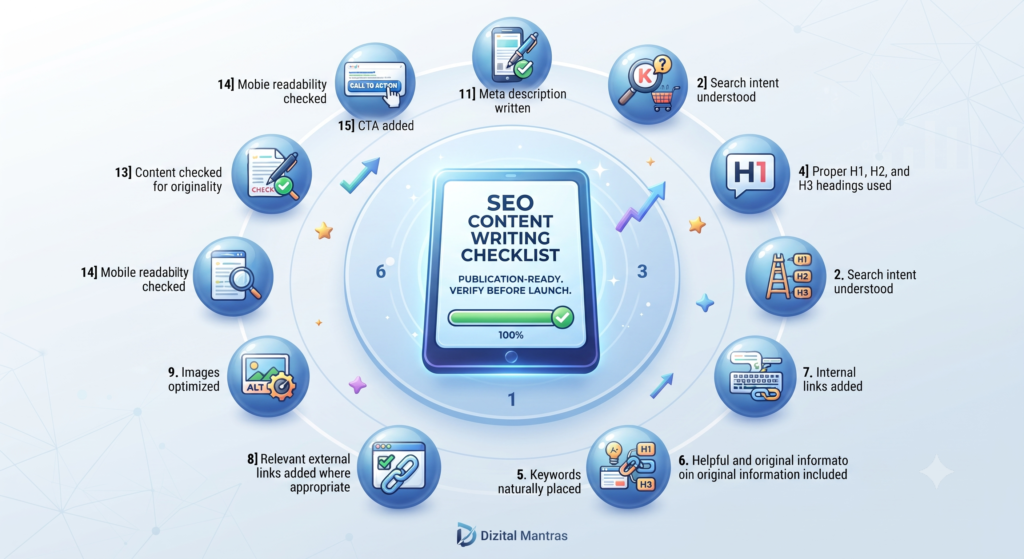
SEO Content Writing Checklist
Before publishing your article, use this simple checklist:
- Focus keyword selected
- Search intent understood
- SEO title created
- Proper H1, H2, and H3 headings used
- Keywords naturally placed
- Helpful and original information included
- Internal links added
- Relevant external links added where appropriate
- Images optimized
- Alt text added
- Meta description written
- Content proofread
- Content checked for originality
- Mobile readability checked
- CTA added
This checklist can make your content optimization process more consistent.
Final Thoughts
Learning SEO Content Writing Tips is not about finding a shortcut to the top of Google. It is about learning how to create content that genuinely helps people.
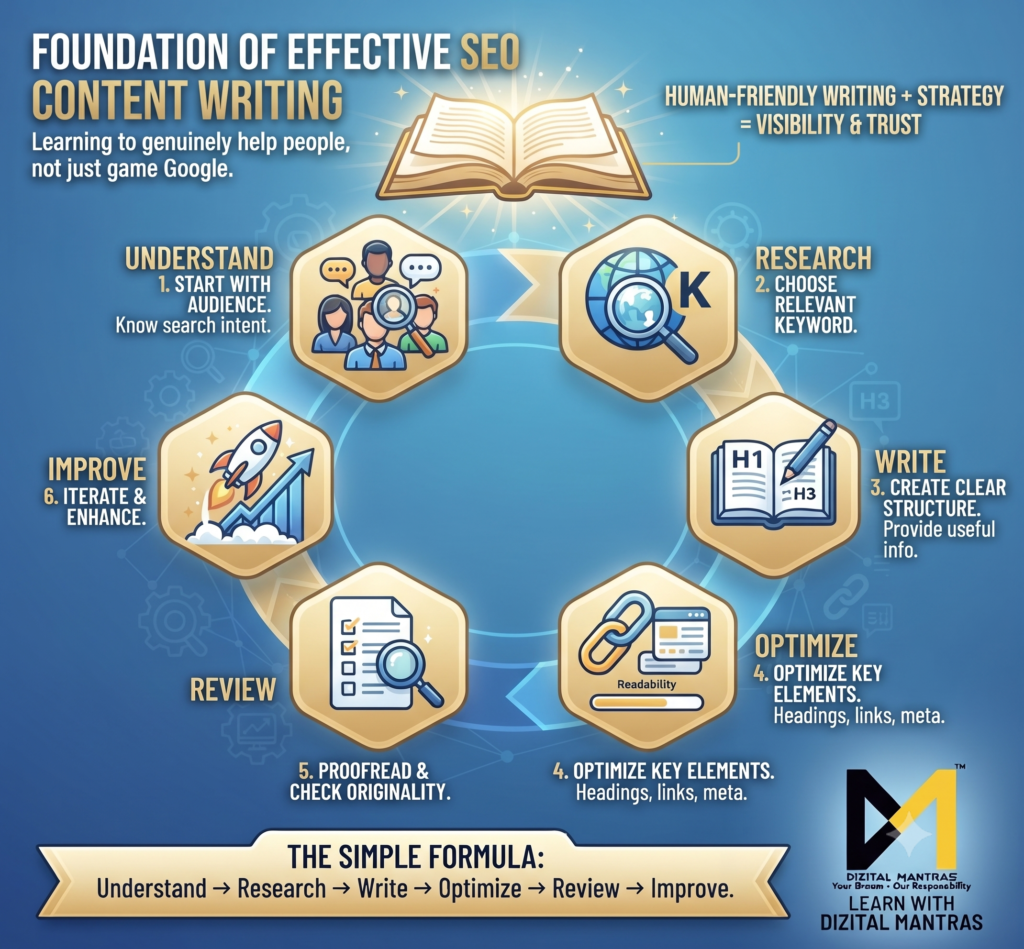
Start with your audience. Understand their search intent, choose a relevant keyword, create a clear structure, and provide useful information. Then optimize important elements such as headings, links, images, meta descriptions, and readability.
The most effective SEO Content Writing Tips combine SEO strategy with human-friendly writing. When readers find your content useful, easy to understand, and relevant to their needs, your website is in a much stronger position to build visibility and trust over time.
If you are developing your digital marketing skills, Dizital Mantras can be a useful place to explore digital marketing and SEO learning opportunities and build practical knowledge.
The simple formula to remember is:
Understand → Research → Write → Optimize → Review → Improve.
That’s the foundation of effective SEO content writing